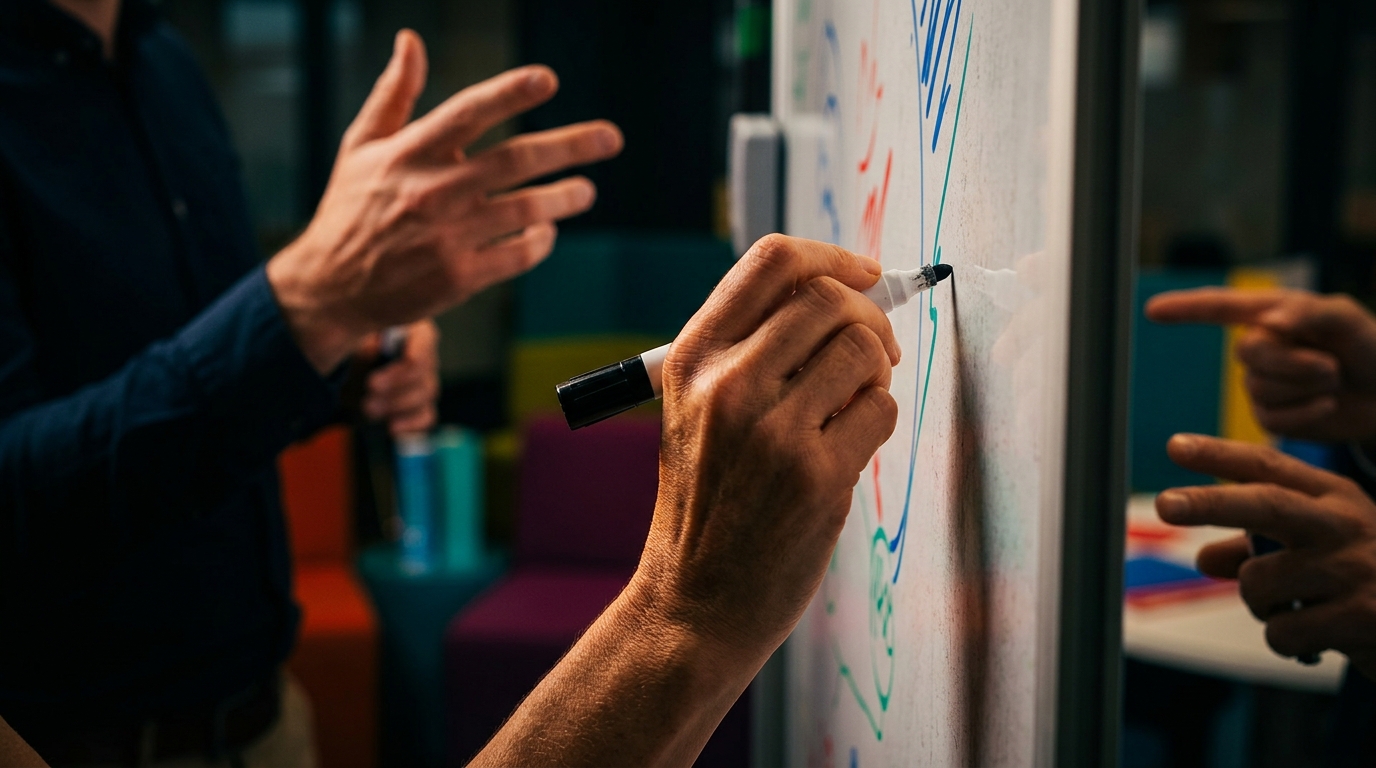

Elena, a senior L&D lead, stood at the back of the conference room watching her flagship negotiation workshop fall apart. She had hired a charismatic external consultant—a high-energy expert who promised to guide the team through a complex simulation. But the room was split into five distinct clusters, each arguing over a different set of constraints. The facilitator was physically trapped at the front of the room, anchored to a whiteboard that couldn't keep pace with the shifting variables of the exercise. He was shouting over the din, trying to summarize the consensus, but he was missing the actual friction points because he couldn't be everywhere at once.
This is the classic failure mode of the human-led corporate workshop. We assume that if we put a high-energy person in the room, the learning will happen through osmosis. But workshops are essentially high-density data environments. When you have thirty people working through a problem, you have thirty simultaneous streams of decision-making. A single facilitator, no matter how skilled, is a bottleneck that restricts the flow of information to whatever they can observe from the podium.
The Shift to Real-Time Data Management
Moving toward an AI facilitator model requires a fundamental change in how you define a workshop. If your goal is to have someone guide the group toward a pre-determined 'correct' answer, you don't need a facilitator; you need a trainer. If your goal is to observe, test, and adapt, then facilitation becomes a task of real-time data management. Elena realized that her human moderator was trying to force a consensus that didn't exist. The participants weren't learning how to negotiate; they were learning how to appease the person holding the microphone.
When you use workshop technology to automate the facilitation layer, you shift the role of the human from 'sage on the stage' to 'architect of the simulation.' You no longer need someone to summarize what the group is doing, because the AI is already mapping the conversation nodes. The human expert is then free to move among the groups, providing deep, idiosyncratic coaching that an algorithm cannot replicate. They move from being a traffic cop to being an expert consultant.
Why AI Normalizes Dissent
There is a counterintuitive truth about corporate workshops: people are often more honest with a neutral, non-judgmental interface than they are with a human. In Elena’s next session, she replaced the human-led consensus-gathering with a structured, AI-mediated feedback loop. The results were startling. In the previous session, the junior associates had remained silent, deferring to the VPs in the room. In the AI-mediated session, the system collected inputs anonymously and surfaced the most contentious points of the negotiation to the group.
Because the AI had no 'authority,' the participants didn't feel the need to posture. The software served as a mirror, not a judge. It surfaced the disagreements that the human facilitator had previously glossed over to keep the session on schedule. By removing the human moderator’s unconscious bias—their tendency to reward the loudest voices or the most senior opinions—the team was forced to confront the actual friction in their workflow. This is where real behavior change begins. You cannot fix a team process that you aren't willing to acknowledge exists.
Designing for Friction
If you want to integrate this into your own practice, stop looking for AI tools that promise to 'engage' the audience with quizzes or gamification. Those are distractions. Instead, look for tools that capture output. A good AI facilitator should act as a persistent memory for the group. It should track the 'decision trail'—the sequence of assumptions a team makes before they arrive at a conclusion.
When Elena set up the workshop architecture, she focused on three specific artifacts:
- The Constraint Log: An AI-driven tracker that flags whenever a group pivots their strategy based on new, simulated information.
- The Dissent Map: A visualization that displays the most common points of disagreement within the room, surfaced anonymously.
- The Decision Record: A summary of the group’s final output compared against the original constraints they were given.
These artifacts allow the human facilitator to say, 'I see that 60% of you disagreed with the final pricing strategy in the third round. Let’s look at why.' They are no longer guessing. They are working from a map of the room’s actual cognitive load.
Where the Model Fails
We must be honest about the limits of this technology. An AI facilitator fails in environments where the primary objective is emotional repair or high-stakes cultural reconciliation. If your workshop is about addressing a systemic breakdown in trust following a leadership exit, an algorithm is not just useless—it is dangerous. In those moments, the presence of a human is the artifact. The way they listen, the way they hold the silence, and the way they acknowledge the weight of a comment are essential components of the intervention.
Furthermore, this approach is expensive in terms of preparation. You cannot simply drop an AI tool into a generic slide deck. The workshop needs to be designed as a simulation, which requires a deep understanding of the work being performed. If you don't know the job, the AI won't know the friction points, and the whole session will feel like a sterile exercise in data entry. This is not a plug-and-play solution. It is a rigorous, custom-built framework that demands as much from the designer as it does from the participants.
Next Steps for the Practitioner
Do not try to automate your entire workshop. Start by identifying the 'bottleneck' in your current sessions. Is it the brainstorming phase where the same three people dominate? Is it the wrap-up where the action items are forgotten by the time the participants reach the parking lot?
Next week, run a 30-minute session where you play the role of the 'system manager.' Use a simple digital whiteboard or a text-based input tool to aggregate anonymous contributions in real-time. Do not comment on them. Do not filter them. Just project the raw data on the wall and ask the group, 'What does this data tell us about how we just solved this problem?'
You will be surprised at how quickly the group stops looking at you and starts looking at the problem. That is the moment the workshop actually begins.